

Can I use AI to research a role I've never recruited for?
- Jodi Marchewitz
- Aug 14
- 5 min read

You can, and a lot of recruiters are trying it right now. A hard role lands on the desk, nobody in-house has filled one before, so they open ChatGPT, or Gemini, or whatever AI tool is closest, and start asking it to explain the market. It feels productive. The problem is that it rarely produces a search that actually fills, and the reason it fails is not the one most people assume.
What happened
Picture a team that gets handed a Senior Product Manager search for a product area they have never hired for. No expert on staff, no budget for an agency yet, so the recruiter does the sensible-looking thing: they turn to AI. They ask it what a great PM looks like, what to put in the job description, what questions to ask. They spend the week building a research doc, feel ready, and kick off the search.
Six weeks later the role is still open. The shortlist keeps missing. The hiring manager has started forwarding their own candidates and asking, quietly, whether they should just call an agency.
It failed, but not for the reason you think
The easy conclusion is that the AI gave bad answers. It didn't. The answers were fine. Generic, but fine.
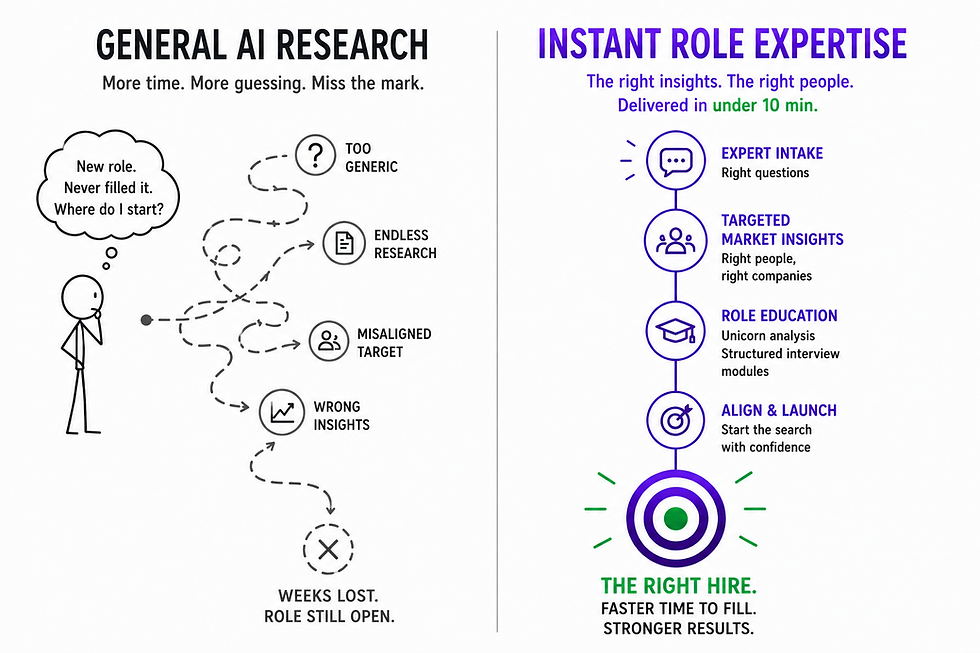
That is exactly the trap. AI does not fail loudly here, it fails invisibly, because a general tool can only answer the question you know how to ask. And on a role you have never filled, you don't know what to ask. You don't know that the title on the req is off-market and quietly shrinking your pool to zero. You don't know the two adjacent titles where this talent actually hides, or the specific companies that grow the kind of PM this team needs, or the comp reality that makes half the wish list impossible. You don't know the one question that would have surfaced the unstated need the hiring manager forgot to mention. So you ask the obvious questions, you get competent, obvious answers, and you walk into the search confidently pointed at the wrong target.
Because you can't research your way to expertise you don't have
This is the unique reason these searches stall. Aligning with the hiring manager is where a search is won or lost, and alignment takes expertise, not effort. A blank prompt does not give you the judgment to challenge a bad requirement or pull out what was never spelled out. It gives you a tidy summary of what you already suspected. That is not a sourcing problem, it is an expertise problem, and it is the one gap a general AI tool cannot close for you, because it only reflects back the level of expertise you brought to the prompt.
What it cost
So the hours pile up on the wrong things. The recruiter researches, sources, and interviews against a target that was slightly off from day one, which is worse than starting late, because everyone believes the search is on track until the misses stack up. Then the search pivots, the requirements get rewritten mid-stream, and the calendar resets. The role sits open, hiring fatigue sets in, and the strongest candidates who were available at kickoff have taken other jobs. And the most expensive loss is the one that does not show up on an invoice: every week the search drifts, the hiring manager loses a little more confidence, until they stop partnering and start pushing for the agency, the outside expert who they believe can finally get it right. You spent two days with an AI chatbot to avoid an agency fee, and ended up on the fast track to paying one anyway.
There is another way
The fix is not a better prompt. It is closing the expertise gap before the search starts, so your recruiter walks in already knowing what an expert on that role would know.
That is what HireBoost.ai does. Instead of asking a blank tool to explain a market you don't know, you give it the role, and in under 10 minutes it hands your recruiter the complete expert strategy for that specific search. It is not general information, it is the Recruiter Brain: the exact intake questions to pull out what the hiring manager forgot to tell you, a unicorn analysis with job modifications that widen the pool, flags on the off-market titles and comp that would have sunk the search, the target companies and career paths where the right people actually are, and the competencies to assess them against. It is the judgment a 15-year expert recruiter brings to a kickoff, installed for the role in front of you, so you are not guessing what to ask, you already have the questions.
You align from the very start
With that role intelligence in hand, your recruiter walks into the kickoff as the expert in the room. They have the standing to push back on the requirement that was quietly killing the search, and the specific questions that surface what was never written down. The search starts pointed at the right target instead of a plausible-looking wrong one, so it starts right and fills faster, and the hiring manager stops second-guessing and starts partnering.
The expertise stays, and it compounds
And unlike a research doc you build from scratch every time, this is a repeatable framework, not a one-off. The next unfamiliar role, an ML engineer, a controller, a business development lead, runs through the same expert process and generates fresh, role-specific intelligence for that search.
But the bigger shift is what it does to your recruiters. Every search teaches them to think strategically instead of reactively, to start from real data on the role and the market instead of a keyword and a hunch, so they come out of each one sharper than they went in. That is the compounding: your recruiters get up-leveled with every search, not just the req they happen to be working. So your team is not re-Googling the market on every hard role, they are learning to think like an expert recruiter on any role, and the expertise that used to walk out the door with an agency instead lives in-house and gets stronger with every search.
The short version
AI can summarize a role for you, but it cannot give you the expertise to know what to ask about a role you have never filled, and that gap is exactly where these searches quietly fail: wrong target, wasted weeks, mid-search pivots, and a hiring manager who loses faith and reaches for an agency. The answer is not a smarter prompt, it is installing real recruiting expertise before the search starts, so any recruiter can align, source, and assess like an expert on any role. Slow hiring isn't a research problem. It's an expertise problem.
So be honest about the searches on your desk right now. When you hand a recruiter a role no one has filled before, are they walking in as the expert, or are they opening a blank chat window and hoping the right questions occur to them? How is that working out?


Comments